

SUBMISSION CHECKLIST • Use a red-amber-green audit before you click submit
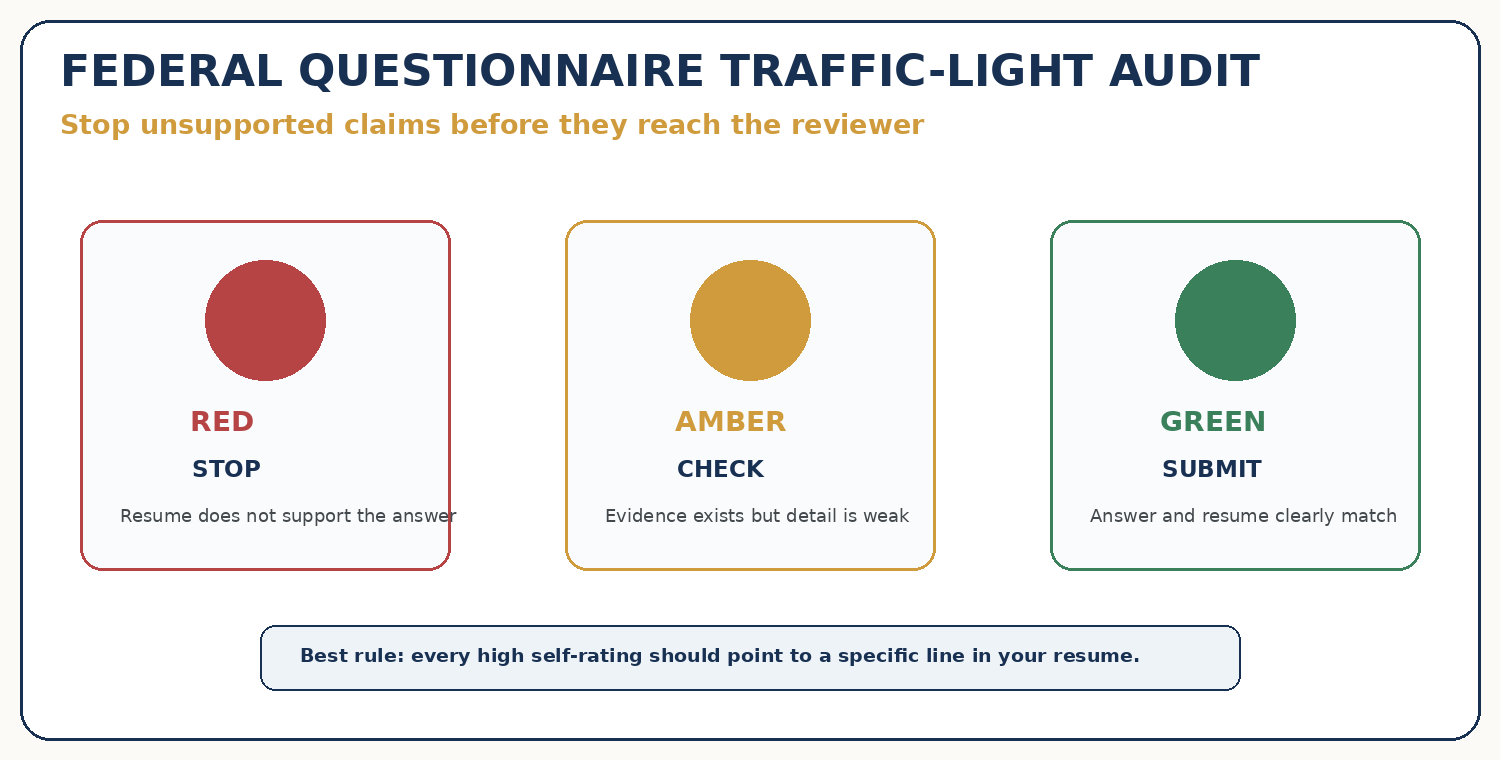
Use This Rule Before Every Answer
A federal questionnaire answer is only as strong as the evidence behind it. If you claim advanced experience, your resume and supporting documents should make that experience easy for a reviewer to find.
Applicants reviewing Postal Service Jobs should treat questionnaire responses, work history, licenses, and required documents as one connected application package.
The Red-Amber-Green Audit
|
|
|
|
Audit 1: Is This an Eligibility Question or an Experience Question?
Eligibility items ask whether you meet a legal or appointment condition, such as citizenship, veteran status, location, security requirements, or willingness to work the stated schedule. Experience items measure what you have done and at what level.
Do not guess on eligibility. An incorrect answer can remove you before a reviewer reaches the rest of the application.
Audit 2: What Level Are You Claiming?
|
|
|
|
|
Choose the highest level you can support. A truthful independent rating is stronger than an expert rating that has no matching proof in your resume.
Audit 3: Can a Reviewer Find the Proof in 20 Seconds?
For every strong self-rating, locate the exact resume line that proves it. If the proof is buried in vague text, rewrite the bullet so the duty, responsibility, frequency, and scope are clear.
- Name the system, process, or duty.
- Show whether you worked independently.
- Include dates and hours per week where relevant.
- Explain the size, volume, or complexity of the work.
- Add a result when it helps demonstrate responsibility.
Audit 4: Are Your Dates and Hours Clear Enough?
Federal reviewers often need enough detail to determine the amount of qualifying experience. Current federal hiring guidance commonly asks for employer, title, start and end dates, and hours worked per week.
If a vacancy requires one year of specialized experience, the reviewer needs enough information to verify that duration. A title alone does not prove it.
Audit 5: Did You Rewrite the Announcement Instead of Your Experience?
Copying the vacancy's duty statements into your resume creates weak evidence. It tells the reviewer what the job requires, not what you did.
Use your own work history. Describe how you performed the task, the level of independence, and the result. Keep the language specific enough that the reviewer does not have to infer your experience.
Audit 6: Are You Overrating Yourself?
A useful check is to read the answer as if you were the reviewer. If the response says you are an expert, ask what evidence would convince a stranger of that level. Strong proof might include leading a process, training others, independently solving complex cases, reviewing other employees' work, or being the person others rely on for difficult problems. If your resume only shows basic exposure, choose a lower level.
Consistency also matters later. A questionnaire answer may be compared with your resume, supporting records, and interview responses. If the application says you regularly performed a complex duty but you cannot explain a real example during an interview, the mismatch weakens credibility.
Selecting the top option on every question is risky. Federal announcements often warn that overstating qualifications or experience can lead to removal from consideration.
A strong application is consistent. Your questionnaire, resume, interview, and documents should tell the same story.
Audit 7: Did You Upload Every Required Document?
One final detail is version control. If you revise a resume after starting an application, confirm the final file attached to the vacancy is the version you intended to submit. A strong questionnaire paired with an older or incomplete resume creates the same evidence problem as a weak answer.
|
|
|
|
|
|
|
|
|
|
|
|
|
|
|
|
|
|
How This Applies to USPS Applications
USPS positions do not all use the same application system or screening method. Entry roles may use standardized assessments, while professional, administrative, technical, or supervisory jobs may rely more heavily on work history and vacancy-specific qualification questions.
When reviewing USPS jobs pay close attention to the position-specific requirements instead of assuming every postal application follows one format.
A 5-Minute Final Review
- Open the questionnaire and resume side by side.
- Check every answer where you selected an advanced level.
- Find the matching resume proof.
- Confirm dates, hours, and required documents.
- Verify the closing date and time zone.
- Submit, then confirm the application package was received.
USAJOBS explains the official application workflow in its How to Apply guidance, including the need to review the questionnaire and ensure the resume supports your answers.
Frequently Asked Questions
Should I choose the highest answer every time?
No. Choose the highest level you can support truthfully.
Does my resume need to prove questionnaire answers?
Yes. Federal guidance specifically expects the resume to support the responses.
What if my experience is real but not written clearly?
Rewrite the resume with dates, scope, duties, and responsibility level before submitting.
Can missing documents hurt the application?
Yes. Required documents must generally be received by the deadline.
What is the safest final check?
For every high self-rating, point to the exact resume evidence that supports it.
Save a copy of the final package for your own records before the announcement closes.
This also helps you answer later interview questions with the same facts and dates.
Bottom Line
Federal questionnaires are easiest to handle when you treat them as an evidence audit. Red means unsupported. Amber means the proof needs work. Green means your answer, resume, and documents line up clearly. That approach reduces avoidable qualification problems and gives the reviewer a consistent application to evaluate.

Leave a Reply